



A Complete Guide to the FIFA World Cup 2026™
The world's most-watched sport is returning in 2026, set to be the biggest and most expansive FIFA World Cup™ in history. For the first time ever, the soccer tournament will be co-hosted by three nations and will feature more teams than ever before. Whether you're a die-hard fan or a newcomer to the sport, our Experts break down everything you need to know about the 2026 FIFA World Cup™.
FIFA World Cup™ History Overview
Almost 100 years of history has brought many changes—here’s a quick breakdown of how the championship has evolved.
-
1930: The first-ever FIFA World Cup™ was hosted in Uruguay, spanning 27 days with 13 nations competing.
-
1954: The tournament is broadcast nationally on television, reaching a wider audience.
-
1982: FIFA expands the championship to 24 teams.
-
1998: The traditional 32-team competition is created, lasting seven tournaments until 2022.
-
2026: The event expands again to an all-time high of 48 teams.
Learn more about the History of the FIFA World Cup™>
Key Details of the Largest FIFA World Cup™
-
Hosts: For the first time, the tournament will have three hosts: Canada, Mexico, and the United States.
-
Venues: Hosted across 16 cities and stadiums, venues were organized into three regional zones—Western, Central, and Eastern—to help minimize travel.
-
Dates: The event will run from June 11 to July 19, 2026, spanning a total of 39 days.
-
Expanded Teams: The number of qualifying teams has increased from 32 to 48, leading to a record 104 matches.
The Official Match Ball: TRIONDA
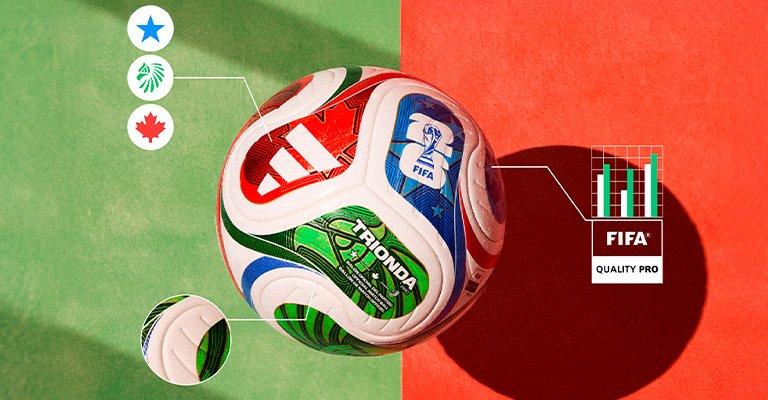
The official match ball for the 2026 FIFA World Cup™ is named the “TRIONDA,” a combination of the Spanish words for three “tri” and wave “onda”. This name symbolizes the three host nations and the wave of unity connecting this multinational championship. Its design features the national colors of Canada (red), Mexico (green), and the United States (blue) and is equipped with a thermally bonded surface and advanced sensor technology.
Why Every Four Years?
Similar to the Olympics, the FIFA World Cup™ is only held once every four years. The decision is based on a mix of factors:
-
Logistics: As one of the biggest events in the world, the tournament takes time to plan, and with a significant increase in matches, this year is no different.
-
Qualification: With over 200 teams competing for a qualifying spot, these matches are spread out over four years. Some confederations begin their qualifying matches 2-3 years before the next championship.
-
Players: Four years allotted players enough time to fully recover and prepare for the next tournament, allowing them to train and compete in continental tournaments.
Host Cities & Venues
With 16 host cities across North America preparing to welcome teams and thousands of fans, the tournament will be divided into three regional zones—Western, Central, and Eastern—to minimize travel for teams and supporters.
U.S. Host Cities & Stadiums
| City | Stadium |
|---|---|
| Atlanta, Georgia | Mercedes-Benz Stadium |
Boston, Massachusetts | Gillette Stadium |
Dallas, Texas | AT&T Stadium |
Houston, Texas | NRG Stadium |
Kansas City, Missouri | Arrowhead Stadium |
Los Angeles, California | SoFi Stadium |
Miami, Florida | Hard Rock Stadium |
New York / New Jersey | MetLife Stadium |
Philadelphia, Pennsylvania | Lincoln Financial Field |
San Francisco Bay Area, California | Levi’s Stadium |
Seattle, Washington | Lumen Field |
Mexico Host Cities & Stadiums
| City | Stadium |
|---|---|
Guadalajara, Jalisco | Estadio Akron |
Mexico City | Estadio Azteca |
Monterrey, Nuevo León | Estadio BBVA |
Canada Host Cities & Stadiums
City | Stadium |
|---|---|
Toronto, Ontario | BMO Field |
Vancouver, British Columbia | BC Place |
All New Format
The most significant change in almost 30 years is the expansion from 32 to 48 teams. This format is designed to increase opportunities for more nations while maintaining a competitive group stage and an exciting knockout phase.
How It Works
The FIFA World Cup™ is divided into two main sections: the Group Stage and the Knockout Stage.
Group Stage
The tournament kicks off with the group stage, where the 48 qualified teams are split into 12 groups of four. Each team will play every other team in its group once—the top two teams from each group will advance to the next phase.
Knockout Stage
The 24 winning teams, plus the eight best third-place teams from the group stage, will advance to the knockout stage. This is now a single-elimination bracket, where every match is considered ‘sudden death’, a team either wins and advances or loses and is eliminated from the tournament.
Learn more about How the Tournament Works >
Qualifying
The 2026 FIFA World Cup™ qualification process has been overhauled to accommodate the expanded 48-team lineup. As host nations, the United States, Canada, and Mexico all automatically qualify. The remaining 45 spots are being contested by teams around the world through their respective confederation's qualifying tournaments.
Here is a breakdown of each confederation’s qualification slots and what to expect:
-
AFC (Asian Football Confederation): Asia gets 8 direct slots and 1 inter-confederation playoff slot.
-
CAF (Confederation of African Football): Allotted 9 direct slots and 1 inter-confederation playoff slot.
-
CONCACAF (Confederation of North, Central America & Caribbean): In addition to the three host nations, CONCACAF has 3 direct slots and 2 inter-confederation playoff slots to fill.
-
CONMEBOL (South American Football Federation): South America receives 6 direct slots and 1 inter-confederation playoff slot.
-
OFC (Oceania Football Confederation): For the first time, Oceania will have 1 direct slot and 1 inter-confederation playoff slot.
-
UEFA (Union of European Football Associations): The largest confederation to compete, UEFA has 16 direct slots and no playoff slots.
Who has qualified so far?
Qualifying for the 2026 FIFA World Cup™ has been underway since 2023, with several nations already stamping their tickets to North America. As of December 2025, the following teams have qualified:
-
AFC: Japan, Iran, South Korea, Uzbekistan, Australia, Jordan, Qatar, Saudi Arabia
-
CAF: Algeria, Cabo Verde, Côte d'Ivoire, Egypt, Ghana, Morocco, Senegal, South Africa, Tunisia
-
CONCACAF (Hosts): United States, Canada, Mexico, Curaçao, Haiti, Panama
-
CONMEBOL: Argentina, Brazil, Ecuador, Paraguay, Uruguay, Colombia
-
OFC: New Zealand
-
UEFA: Austria, Belgium, Croatia, England, France, Germany, Netherlands, Norway, Portugal, Scotland, Spain, Switzerland
Key Dates
As the FIFA World Cup™ approaches, here are important dates to keep in mind:
-
The Final Draw - December 5th, 2025: At the John F. Kennedy Center for the Performing Arts in Washington, DC.
-
Final Qualifying Matches - March 26th & 31st, 2026: Hosted in one or more of the host countries.
-
Opening Match - June 11th, 2026: The first tournament match will take place in Mexico City's Estadio Azteca.
-
Final Match - June 19th, 2026: The championship match will be held at MetLife Stadium in New York/New Jersey.
With more teams than ever and matches hosted across North America, the biggest FIFA World Cup™ in history is a can’t-miss event. Whether you're heading to a host city or supporting from home, understanding the basics of the 2026 event will make watching even more enjoyable. For team gear and other FIFA World Cup™ essentials, head into your local SCHEELS to stock up.